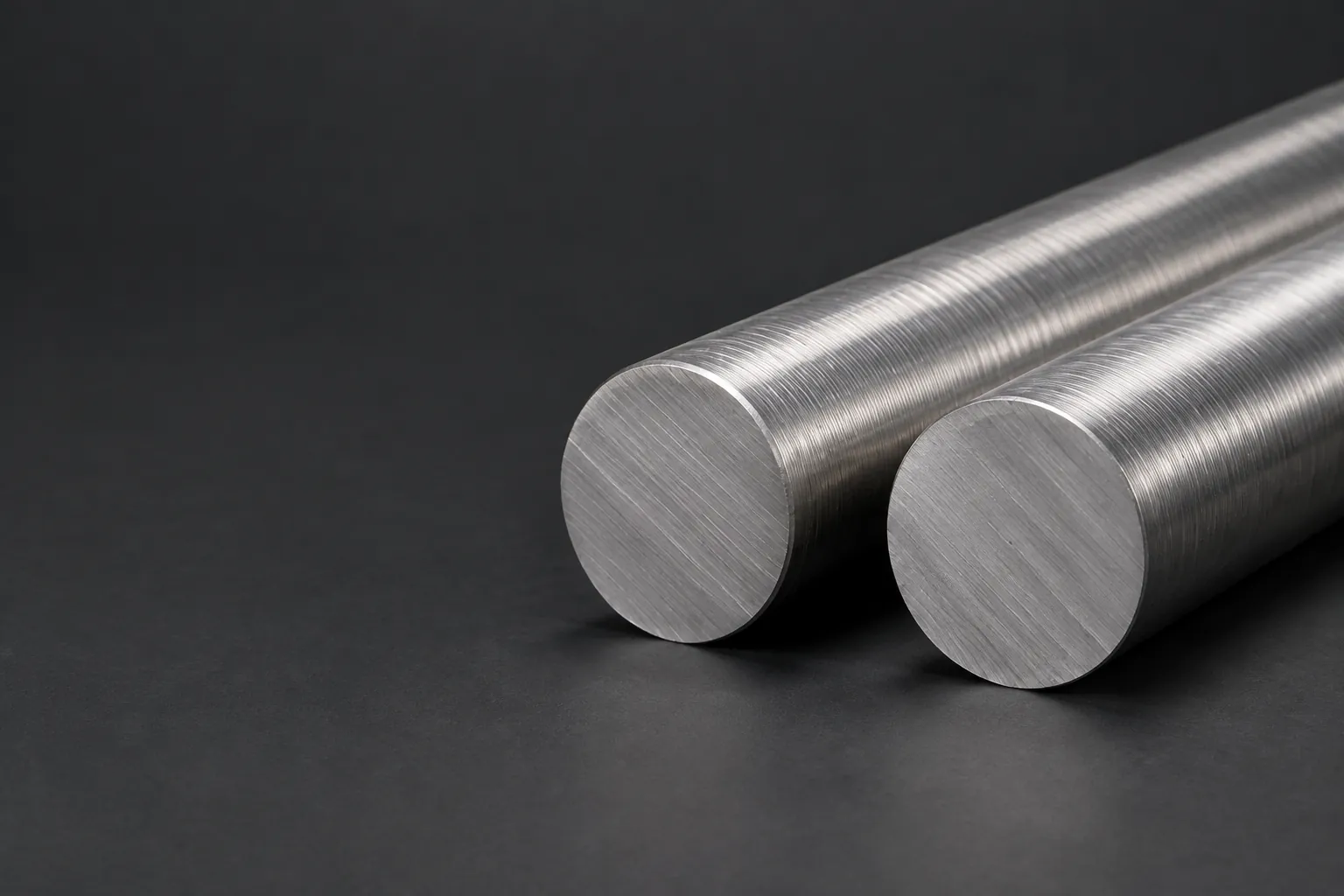
Materials Supply / Stainless Steels
Custom 455 Stainless Steel
Martensitic Precipitation-Hardening Stainless Steel | UNS S45500
Proprietary martensitic age-hardenable stainless steel combining copper and titanium strengthening with useful annealed formability.
Supply condition and ageing determine the balance of strength, hardness and toughness. Condition-specific reference data must not be transferred between bar, plate, strip or forgings.
Custom 455® is a registered trademark of CRS Holdings Inc., a subsidiary of Carpenter Technology Corporation, as attributed in the cited producer datasheet; it is not a generic equivalent of another stainless grade.
Raw & semi-finished materials
Available material forms
Potential forms supported by the cited producer/specification references; dimensions, supply condition, availability and certification must be confirmed. No Quest Engineering stock holding is implied.
- Round Bar
- Flat Bar
- Strip
- Wire
- Forgings
- Cut-to-Size Material
Material overview
Custom 455 Stainless Steel
Proprietary martensitic age-hardenable stainless steel combining copper and titanium strengthening with useful annealed formability.
- Proprietary martensitic age-hardenable stainless steel combining copper and titanium strengthening with useful annealed formability.
- This is a proprietary alloy; similar chemistries are not generic equivalents.
- Verify the ordered product specification, ageing condition, size and test requirements for the application.
Material specifications & designations
| Designation | Reference |
|---|---|
| UNS | S45500 |
| Common designation | Custom 455 |
| AMS 5617 | Bars, wire, forgings and forging stock; solution heat treated per SAE public scope and Carpenter listing. Rev L listed January 2024; full current requirements not reviewed. |
| AMS 5860 | Strip, per Carpenter producer listing; confirm exact condition and revision |
| ASTM A564 / A693 (XM-16) | Bars/wire/shapes / sheet/plate/strip; Carpenter designation, not an equivalence to Custom 465 |
| EN reference | No EN material number asserted: exact chemistry, product-form standard and contractual equivalence require separate verification. |
Specification applicability follows product form and condition, not similar chemistry. Public scope/producer listings were checked, but current full AMS/ASTM/EN acceptance tables were unavailable. Confirm the purchased revision and any slash-condition designation; no aerospace conformity is promised without matching certificates. Reference associations only: no equivalence, stock availability, aerospace approval or certified conformity is established by this page. Specify the ordered revision, product form, dimensions, manufacture/melt route, delivery condition and acceptance tests; obtain matching supplier confirmation and inspection documents.
Specification review
Technical verification requirements
designations / product forms
Public grade associations do not establish revision-specific acceptance for every listed standard and offered form. Each row remains subject to contractual form, grade, process and delivery-condition checking; pipe is not generic tube, forging stock is not a finished forging, and long-product AMS is not flat product approval. This is an evidence gap, not a finding that all listed mappings are wrong.
Obtain ordered revisions; sign off each listed row against grade, form, size, melt route, condition and any slash designation; document offered tube specification separately where relevant.
mechanical / physical / certification
Published reference data are not a Quest certified delivery envelope. Some tables explicitly lack orientation, specimen size or test temperature; preserve those caveats. Conditional certificate/PMI/UT availability is not evidence of actual supplier capability or aerospace approval.
Retain typical-versus-minimum distinctions; confirm actual purchase-order test orientation, dimensions, temperature and certificate/test acceptance requirements before publication or supply.
Engineering reference
Technical data
| Element | Minimum % | Maximum % |
|---|---|---|
| Carbon | — | 0.05 |
| Chromium | 11.00 | 12.50 |
| Nickel | 7.50 | 9.50 |
| Copper | 1.50 | 2.50 |
| Titanium | 0.80 | 1.40 |
| Niobium + Tantalum (combined) | 0.10 | 0.50 |
| Molybdenum | — | 0.50 |
| Manganese | — | 0.50 |
| Silicon | — | 0.50 |
| Phosphorus | — | 0.040 |
| Sulphur | — | 0.030 |
| Iron | Balance | Balance |
Single producer composition basis from the cited ATI or Carpenter datasheet; displayed ranges and explicitly stated maxima are reference data, not independently verified current ASTM/AMS limits. The 0.10–0.50% limit is combined niobium (columbium) plus tantalum, not a separate limit for each element. All values are mass percentages (wt. %); a dash means no bound specified on that side, not zero. No heat analysis or grade substitution is implied.
| Property | Indicative value | Condition / temperature |
|---|---|---|
| Density | ≈ 7.76 g/cm³ | Condition A; nominal ambient |
| Density | ≈ 7.79 g/cm³ | H950; nominal ambient |
| Elastic modulus | ≈ 200 GPa | Producer nominal; converted from 29,000 ksi; exact temperature/condition unstated |
Typical producer values, not acceptance limits or design allowables. Conditions and temperature intervals are stated wherever supplied; nominal ambient means exact temperature is not identified. Unsupported graph estimates and resistivity without test temperatures are omitted.
Condition A
| Property | Reference value | Basis |
|---|---|---|
| Ultimate tensile strength | 1000 MPa | Typical producer reference |
| 0.2% proof strength | 793 MPa | Typical producer reference |
| Elongation (4D) | 14% | Typical producer reference |
| Hardness | 31 HRC | Typical producer reference |
| Reduction of area | 60% | Typical producer reference |
Carpenter p. 7, typical room-temperature properties of 25.4 mm (1 inch) section bar. All properties use this one table, not the 102 mm bar or strip tables. No specimen orientation is specified; impact values omitted without full specimen requirements.
H900
| Property | Reference value | Basis |
|---|---|---|
| Ultimate tensile strength | 1724 MPa | Typical producer reference |
| 0.2% proof strength | 1689 MPa | Typical producer reference |
| Elongation (4D) | 10% | Typical producer reference |
| Hardness | 49 HRC | Typical producer reference |
| Reduction of area | 45% | Typical producer reference |
Carpenter p. 7, typical room-temperature properties of 25.4 mm (1 inch) section bar. All properties use this one table, not the 102 mm bar or strip tables. No specimen orientation is specified; impact values omitted without full specimen requirements.
H950
| Property | Reference value | Basis |
|---|---|---|
| Ultimate tensile strength | 1620 MPa | Typical producer reference |
| 0.2% proof strength | 1551 MPa | Typical producer reference |
| Elongation (4D) | 12% | Typical producer reference |
| Hardness | 48 HRC | Typical producer reference |
| Reduction of area | 50% | Typical producer reference |
Carpenter p. 7, typical room-temperature properties of 25.4 mm (1 inch) section bar. All properties use this one table, not the 102 mm bar or strip tables. No specimen orientation is specified; impact values omitted without full specimen requirements.
H1000
| Property | Reference value | Basis |
|---|---|---|
| Ultimate tensile strength | 1448 MPa | Typical producer reference |
| 0.2% proof strength | 1379 MPa | Typical producer reference |
| Elongation (4D) | 14% | Typical producer reference |
| Hardness | 45 HRC | Typical producer reference |
| Reduction of area | 55% | Typical producer reference |
Carpenter p. 7, typical room-temperature properties of 25.4 mm (1 inch) section bar. All properties use this one table, not the 102 mm bar or strip tables. No specimen orientation is specified; impact values omitted without full specimen requirements.
H1050
| Property | Reference value | Basis |
|---|---|---|
| Ultimate tensile strength | 1310 MPa | Typical producer reference |
| 0.2% proof strength | 1207 MPa | Typical producer reference |
| Elongation (4D) | 15% | Typical producer reference |
| Hardness | 40 HRC | Typical producer reference |
| Reduction of area | 55% | Typical producer reference |
Carpenter p. 7, typical room-temperature properties of 25.4 mm (1 inch) section bar. All properties use this one table, not the 102 mm bar or strip tables. No specimen orientation is specified; impact values omitted without full specimen requirements.
Solution treatment
Carpenter Condition A guidance: 816–843°C followed by rapid cooling; water quenching is preferred for small sections. No soak time is specified.
Precipitation ageing
Carpenter confirms H900, H950, H1000 and H1050: choose 482°C, 510°C, 538°C or 566°C, respectively, hold four hours and air cool. These converted set points and times are producer guidance, not a substitute for the ordered specification.
Forming and stability
The annealed martensitic alloy has a relatively low work-hardening rate. Cold work before ageing changes the response; retain machining allowance and do not apply bar data to spring strip or wire.
Grade-specific producer processing guidance, not a qualified production schedule or guaranteed acceptance specification. Confirm furnace control, precursor condition, section size, hold times, cooling and tests to the ordered standard.
Material selection
Corrosion resistance & performance
Carpenter compares general resistance favourably with 410 and approaching 430 in mild environments, not as a universal 304/316 replacement. High-strength martensitic conditions remain vulnerable to hydrogen and stress-corrosion effects.
Assess medium, temperature, applied stress, crevices, surface finish and heat-treatment history. Remove contamination and heat-treatment scale; no marine suitability or maximum service temperature is implied.
Typical applications
Engineering applications
- High-strength mechanical components
- Precision fasteners
- Spring products with separately specified properties
- Application-qualified aerospace and instrumentation parts
Subsequent manufacturing
Machining & processing
Machinability
Machine in solution-treated or separately specified overaged stock where appropriate. Ageing increases hardness and cutting forces; do not transfer strip data to bar machining.
Work hardening and forming
Cold work changes residual stress and subsequent ageing response. Custom 455 has a relatively low annealed work-hardening rate, but forming limits remain geometry-dependent.
Heat treatment and dimensional stability
Ageing can change dimensions and surface condition; retain appropriate allowance and qualify the full cycle for the product geometry. Low-temperature ageing does not guarantee zero distortion.
Welding and finishing
Use a qualified welding procedure, suitable filler and agreed post-weld heat treatment; matching strength and toughness require specification-specific assessment. Finish and clean surfaces with a grade-appropriate process; avoid embedded carbon-steel contamination.
Material certification & testing
Documentation and testing may be requested subject to supplier and quotation confirmation:
For aerospace orders, certificates must demonstrate conformity to the actual ordered specification, product form and material condition. Tests, traceability and acceptance criteria must be agreed at quotation; no certification is promised in advance.
- EN 10204 3.1 material certificates
- Manufacturer Certificates of Conformity
- Heat/batch traceability
- Chemical analysis
- Mechanical test reports
- Hardness testing
- Heat-treatment records
- Additional testing where required
Material enquiry
Request a material quotation
Custom 455 Stainless Steel supplied to your material form, dimensions and specification.