Materials Supply / Stainless Steels
Custom 465 Stainless Steel
Martensitic Precipitation-Hardening Stainless Steel | UNS S46500
Proprietary high-strength nickel-titanium-molybdenum martensitic age-hardenable stainless steel with condition-dependent strength and toughness.
Supply condition and ageing determine the balance of strength, hardness and toughness. Condition-specific reference data must not be transferred between bar, plate, strip or forgings.
Custom 465® is a registered trademark of CRS Holdings LLC, a subsidiary of Carpenter Technology Corporation, as attributed in the cited producer datasheet; it is not a generic equivalent of another stainless grade.
Raw & semi-finished materials
Available material forms
Potential forms supported by the cited producer/specification references; dimensions, supply condition, availability and certification must be confirmed. No Quest Engineering stock holding is implied.
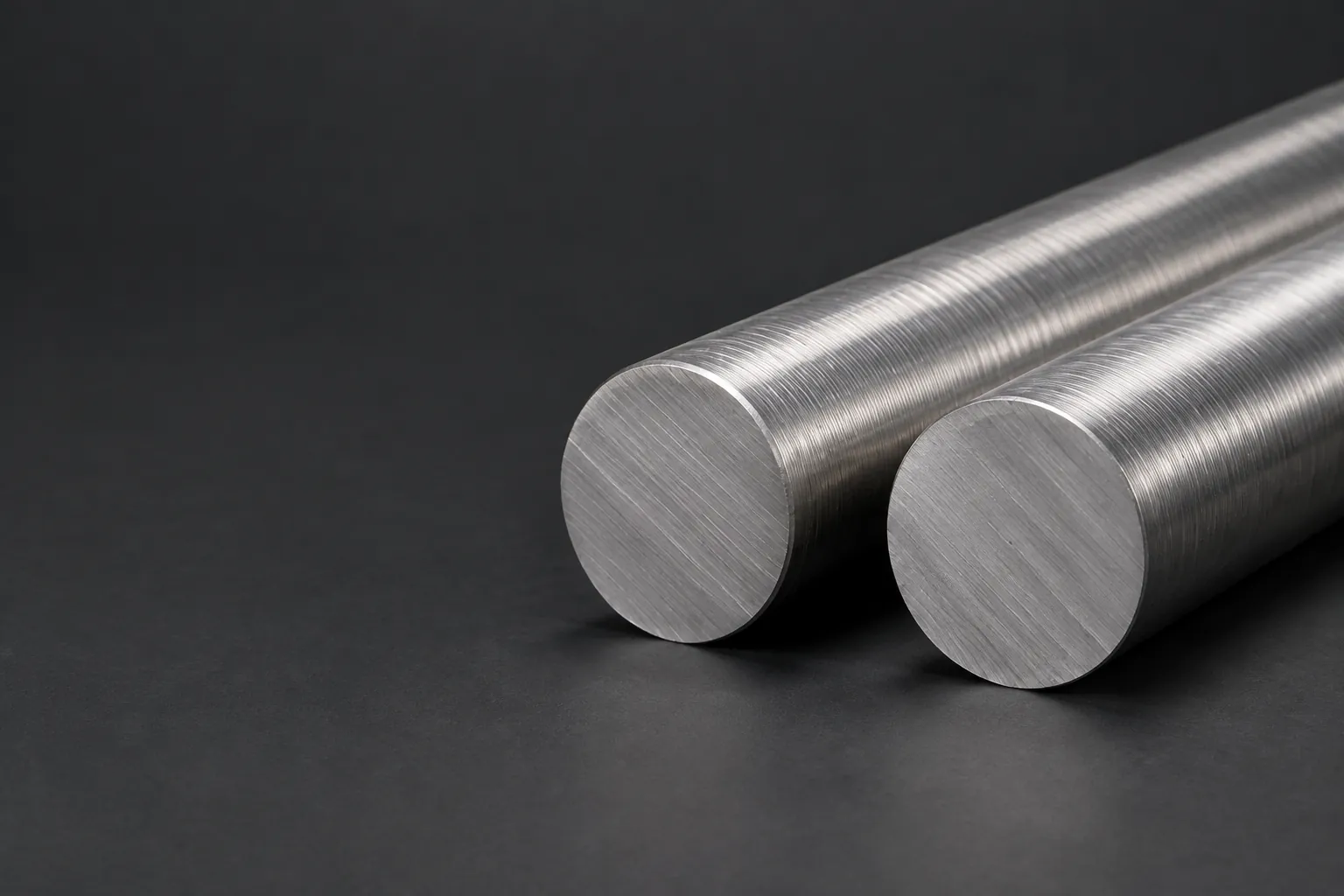
- Round Bar
- Flat Bar
- Strip
- Wire
- Forgings
- Cut-to-Size Material
Material overview
Custom 465 Stainless Steel
Proprietary high-strength nickel-titanium-molybdenum martensitic age-hardenable stainless steel with condition-dependent strength and toughness.
- Proprietary high-strength nickel-titanium-molybdenum martensitic age-hardenable stainless steel with condition-dependent strength and toughness.
- This is a proprietary alloy; similar chemistries are not generic equivalents.
- Verify the ordered product specification, ageing condition, size and test requirements for the application.
Material specifications & designations
| Designation | Reference |
|---|---|
| UNS | S46500 |
| Common designation | Custom 465 |
| AMS 5936 | Bars, wire, forgings and forging stock; solution heat treated, precipitation hardenable. SAE Rev D scope (2019), not a strip mechanical standard. |
| ASTM A564 / A693 | Producer-listed long / flat product specification families; verify current grade scope, form and condition. |
| ASTM F899 | Producer-listed wrought stainless steel for surgical instruments; application-specific requirements, not blanket aerospace approval |
| EN reference | No EN material number asserted: exact chemistry, product-form standard and contractual equivalence require separate verification. |
Specification applicability follows product form and condition, not similar chemistry. Public scope/producer listings were checked, but current full AMS/ASTM/EN acceptance tables were unavailable. Confirm the purchased revision and any slash-condition designation; no aerospace conformity is promised without matching certificates. Reference associations only: no equivalence, stock availability, aerospace approval or certified conformity is established by this page. Specify the ordered revision, product form, dimensions, manufacture/melt route, delivery condition and acceptance tests; obtain matching supplier confirmation and inspection documents.
Specification review
Technical verification requirements
designations / product forms
Public grade associations do not establish revision-specific acceptance for every listed standard and offered form. Each row remains subject to contractual form, grade, process and delivery-condition checking; pipe is not generic tube, forging stock is not a finished forging, and long-product AMS is not flat product approval. This is an evidence gap, not a finding that all listed mappings are wrong.
Obtain ordered revisions; sign off each listed row against grade, form, size, melt route, condition and any slash designation; document offered tube specification separately where relevant.
mechanical / physical / certification
Published reference data are not a Quest certified delivery envelope. Some tables explicitly lack orientation, specimen size or test temperature; preserve those caveats. Conditional certificate/PMI/UT availability is not evidence of actual supplier capability or aerospace approval.
Retain typical-versus-minimum distinctions; confirm actual purchase-order test orientation, dimensions, temperature and certificate/test acceptance requirements before publication or supply.
Engineering reference
Technical data
| Element | Minimum % | Maximum % |
|---|---|---|
| Carbon | — | 0.02 |
| Chromium | 11.00 | 12.50 |
| Nickel | 10.75 | 11.25 |
| Titanium | 1.50 | 1.80 |
| Molybdenum | 0.75 | 1.25 |
| Manganese | — | 0.25 |
| Silicon | — | 0.25 |
| Phosphorus | — | 0.015 |
| Sulphur | — | 0.010 |
| Iron | Balance | Balance |
Single producer composition basis from the cited ATI or Carpenter datasheet; displayed ranges and explicitly stated maxima are reference data, not independently verified current ASTM/AMS limits. All values are mass percentages (wt. %); a dash means no bound specified on that side, not zero. No heat analysis or grade substitution is implied.
| Property | Indicative value | Condition / temperature |
|---|---|---|
| Density | ≈ 7.81 g/cm³ | Annealed/CT; nominal ambient |
| Density | ≈ 7.83 g/cm³ | H950; nominal ambient |
| Density | ≈ 7.84 g/cm³ | H1000; nominal ambient |
| Density | ≈ 7.86 g/cm³ | H1100; nominal ambient |
| Elastic modulus | ≈ 199 GPa | H1000; converted from 28,800 ksi, exact test temperature unstated |
| Thermal conductivity | ≈ 14.06 W/(m·K) | Annealed/CT; at 23°C |
| Thermal conductivity | ≈ 15.83 W/(m·K) | H1000; at 23°C |
| Mean thermal expansion coefficient | ≈ 10.3 × 10⁻⁶/K | Annealed/CT; mean 25–100°C |
| Electrical resistivity | ≈ 946 nΩ·m | Annealed/CT; at 21°C, converted from 946 microohm·mm |
| Electrical resistivity | ≈ 822 nΩ·m | H1000; at 21°C, converted from 822 microohm·mm |
Typical producer values, not acceptance limits or design allowables. Conditions and temperature intervals are stated wherever supplied; nominal ambient means exact temperature is not identified. Unsupported graph estimates and resistivity without test temperatures are omitted.
Annealed/CT
| Property | Reference value | Basis |
|---|---|---|
| Ultimate tensile strength | 1000 MPa | Typical producer reference |
| 0.2% proof strength | 724 MPa | Typical producer reference |
| Elongation (50.8 mm) | 7% | Typical producer reference |
| Hardness | 30 HRC | Typical producer reference |
Carpenter March 2025 p. 13 typical room-temperature longitudinal strip properties, thickness 3.56 mm (0.140 inch) and under. These are strip references, not AMS 5936 bar/forging acceptance data. No reduction of area or impact values are transferred from 3–9 inch rounds.
H950
| Property | Reference value | Basis |
|---|---|---|
| Ultimate tensile strength | 1724 MPa | Typical producer reference |
| 0.2% proof strength | 1655 MPa | Typical producer reference |
| Elongation (50.8 mm) | 6% | Typical producer reference |
| Hardness | 50.5 HRC | Typical producer reference |
Carpenter March 2025 p. 13 typical room-temperature longitudinal strip properties, thickness 3.56 mm (0.140 inch) and under. These are strip references, not AMS 5936 bar/forging acceptance data. No reduction of area or impact values are transferred from 3–9 inch rounds.
H1000
| Property | Reference value | Basis |
|---|---|---|
| Ultimate tensile strength | 1551 MPa | Typical producer reference |
| 0.2% proof strength | 1482 MPa | Typical producer reference |
| Elongation (50.8 mm) | 7% | Typical producer reference |
| Hardness | 48 HRC | Typical producer reference |
Carpenter March 2025 p. 13 typical room-temperature longitudinal strip properties, thickness 3.56 mm (0.140 inch) and under. These are strip references, not AMS 5936 bar/forging acceptance data. No reduction of area or impact values are transferred from 3–9 inch rounds.
H1100
| Property | Reference value | Basis |
|---|---|---|
| Ultimate tensile strength | 1310 MPa | Typical producer reference |
| 0.2% proof strength | 1069 MPa | Typical producer reference |
| Elongation (50.8 mm) | 10% | Typical producer reference |
| Hardness | 42 HRC | Typical producer reference |
Carpenter March 2025 p. 13 typical room-temperature longitudinal strip properties, thickness 3.56 mm (0.140 inch) and under. These are strip references, not AMS 5936 bar/forging acceptance data. No reduction of area or impact values are transferred from 3–9 inch rounds.
Solution treatment and cold treatment
Carpenter March 2025: solution anneal at 982 ±8°C for one hour and cool rapidly. Sections up to 305 mm use a suitable liquid quenchant; larger sections rapidly air cool. For optimum response, cold treat at −73°C for eight hours within 24 hours of solution annealing, then warm to room temperature.
Ageing conditions
Carpenter recognises H950 (510°C), H1000 (538°C) and H1100 (593°C), with general ageing holds of four to eight hours. Water or oil quenching is suggested for optimum toughness; the exact duration and quench depend on the ordered condition and geometry. No condition-specific exact hold is guessed.
Processing limitations
The high-strength H900 route is not selected here: Carpenter warns of significantly degraded toughness compared with higher ageing temperatures. Annealed/CT strip data is not interchangeable with hot-finished billet or cold-drawn medical wire.
Grade-specific producer processing guidance, not a qualified production schedule or guaranteed acceptance specification. Confirm furnace control, precursor condition, section size, hold times, cooling and tests to the ordered standard.
Material selection
Corrosion resistance & performance
Carpenter describes general corrosion resistance approaching 304; H1000 offers a different strength/toughness/SCC balance from H950. Neither is universally immune to chlorides or hydrogen embrittlement.
Assess medium, temperature, applied stress, crevices, surface finish and heat-treatment history. Remove contamination and heat-treatment scale; no marine suitability or maximum service temperature is implied.
Typical applications
Engineering applications
- Landing-gear and structural elements
- Actuator and torque-tube components
- Drive shafts and drilling tools
- Medical tools with separately qualified wire/bar conditions
Subsequent manufacturing
Machining & processing
Machinability
Machine in solution-treated or separately specified overaged stock where appropriate. Ageing increases hardness and cutting forces; do not transfer strip data to bar machining.
Work hardening and forming
Cold work changes residual stress and subsequent ageing response. Specify incoming condition and any intermediate solution treatment with the producer.
Heat treatment and dimensional stability
Ageing can change dimensions and surface condition; retain appropriate allowance and qualify the full cycle for the product geometry. Low-temperature ageing does not guarantee zero distortion.
Welding and finishing
Use a qualified welding procedure, suitable filler and agreed post-weld heat treatment; matching strength and toughness require specification-specific assessment. Finish and clean surfaces with a grade-appropriate process; avoid embedded carbon-steel contamination.
Material certification & testing
Documentation and testing may be requested subject to supplier and quotation confirmation:
For aerospace orders, certificates must demonstrate conformity to the actual ordered specification, product form and material condition. Tests, traceability and acceptance criteria must be agreed at quotation; no certification is promised in advance.
- EN 10204 3.1 material certificates
- Manufacturer Certificates of Conformity
- Heat/batch traceability
- Chemical analysis
- Mechanical test reports
- Hardness testing
- Heat-treatment records
- Additional testing where required
Material enquiry
Request a material quotation
Custom 465 Stainless Steel supplied to your material form, dimensions and specification.