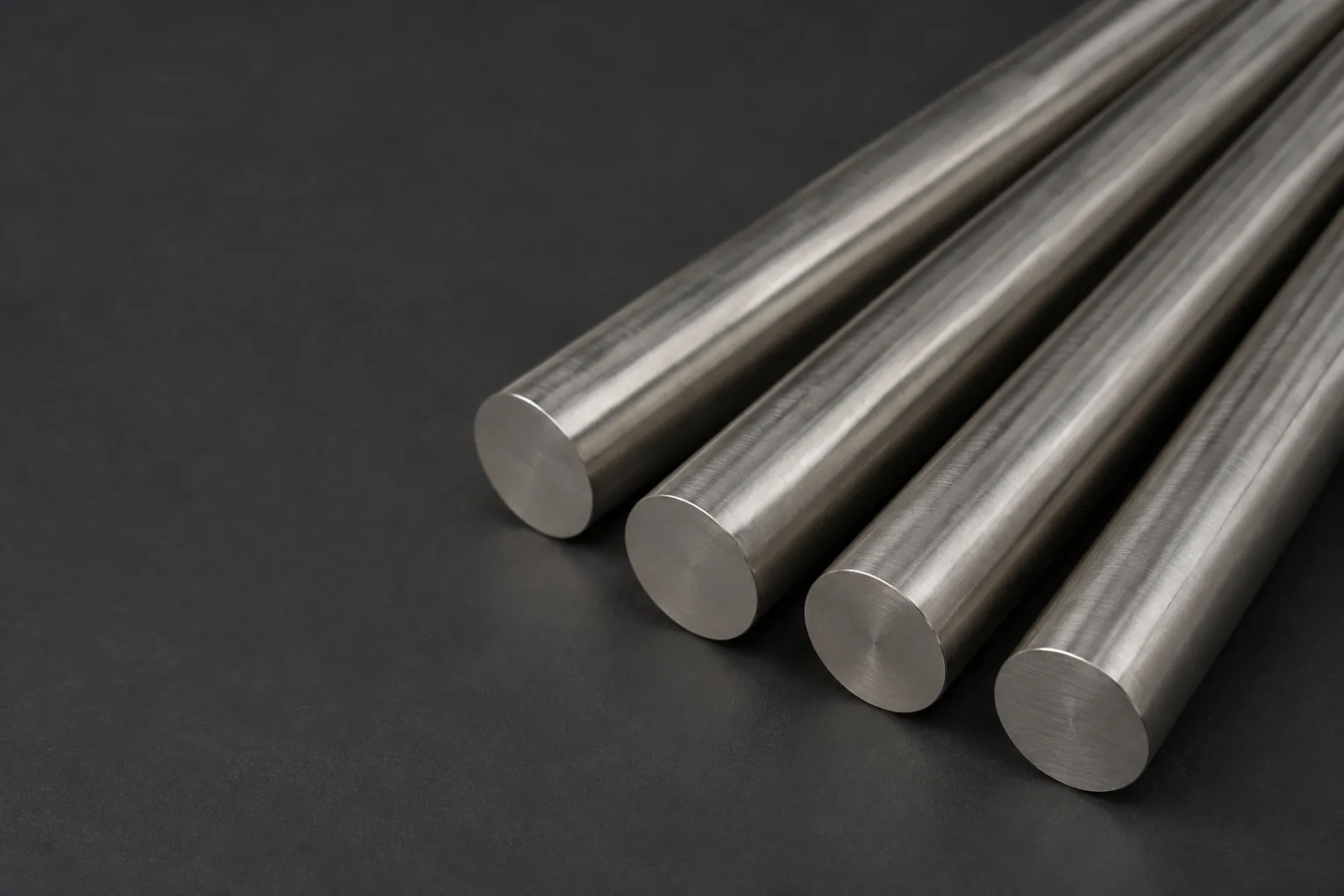
Materials Supply / Nickel, Cobalt & High-Temperature Alloys
Nimonic 80A Nickel Alloy
Age-hardenable nickel-chromium alloy | UNS N07080 | W.Nr. 2.4952; 2.4631
Nimonic 80A is a wrought precipitation-hardenable nickel-chromium alloy strengthened by aluminium and titanium additions. Its strength after ageing depends on product form, processing history and the specified solution-treatment and ageing cycle.
Turbine blades, rings, discs, bolts and exhaust valves are producer-listed applications; suitability depends on loading, temperature, atmosphere and service life.
NIMONIC® is a trademark of the Special Metals Corporation group of companies. Quest Engineering supplies materials to customer requirements and does not manufacture or own this alloy trademark.
Raw & semi-finished materials
Available material forms
Producer-supported forms; availability, dimensions and ordered specification require supplier confirmation. No Quest stockholding is implied.
- Sheet
- Round bar
- Flat bar
- Forging stock
- Hexagon
- Wire
- Plate
- Extruded section
Material overview
Nimonic 80A Nickel Alloy
A wrought, age-hardenable nickel-chromium alloy for specification-led turbine, valve and elevated-temperature component applications.
- Strengthened by titanium, aluminium and carbon additions. Product form and heat treatment must remain attached to each property dataset.
- No graph-derived tensile or creep values are included. Unavailable properties are not zero. Werkstoff numbers are listed without an unsupported form-to-number mapping.
Material specifications & designations
| Designation / standard | Scope / condition |
|---|---|
| UNS | N07080 |
| Werkstoff | 2.4952; 2.4631 |
| BS 3076; BS HR 1; ASTM B637; AECMA PrEN 2188, 2189, 2190, 2396, 2397; AIR 9165-37 | Producer specification references — Rod, bar, wire and forging stock heading; individual scope/condition requires full-standard verification |
| BS HR 201; AECMA PrEN 2191 | Producer specification references — Plate, sheet and strip |
| BS HR 401 | Producer specification reference — Pipe and tube; not an explicit producer available-form listing |
| BS HR 601; DIN 17742; AFNOR NC20TA | Other producer references — Individual scope requires confirmation |
No applicable AMS match was independently verified from SAE. No AMS equivalence is asserted. Specification lists do not establish current editions or supply-condition requirements. Reference associations only: no equivalence, stock availability, aerospace approval or certified conformity is established by this page. Specify the ordered revision, product form, dimensions, manufacture/melt route, delivery condition and acceptance tests; obtain matching supplier confirmation and inspection documents.
Specification review
Technical verification requirements
Specifications / product form
Producer listings and historic references support alloy association but not every listed standard’s current revision, individual form, section-size, melt-route, heat-treatment tolerances or acceptance requirements. Existing qualification wording is appropriate, not proof of conformity.
Obtain controlled ordered-standard and producer confirmation before technical release.
Mechanical condition selectors
Explicit unavailable/not-verified values are correctly distinguished from zero, but selected conditions cannot support a numeric purchasing comparison. Do not fill aged conditions from annealed tables or graph estimates.
Obtain form-, section-, orientation-, temperature- and condition-matched producer or specification tables; otherwise retain explicit gaps.
Engineering reference
Technical data
| Element | Minimum mass % | Maximum mass % |
|---|---|---|
| Carbon | — | 0.10 |
| Chromium | 18.0 | 21.0 |
| Silicon | — | 1.0 |
| Copper | — | 0.2 |
| Iron | — | 3.0 |
| Manganese | — | 1.0 |
| Titanium | 1.8 | 2.7 |
| Aluminium | 1.0 | 1.8 |
| Cobalt | — | 2.0 |
| Boron | — | 0.008 |
| Zirconium | — | 0.15 |
| Lead | — | 0.0025 |
| Sulphur | — | 0.015 |
| Nickel | Balance | Balance |
Single producer table: as BS HR 1, 201, 401 and 601. Balance means nickel predominates; it does not guarantee the entire remainder is nickel. No additional unlisted residual limits are inferred.
| Property | Value | SI unit | Temperature / interval |
|---|---|---|---|
| Density | 8190 | kg/m³ | Not stated |
| Melting range | 1320–1365 | °C | Solidus–liquidus |
| Specific heat (calculated) | 448 | J/(kg·K) | 20°C |
| Specific heat (calculated) | 469 | J/(kg·K) | 100°C |
| Specific heat (calculated) | 494 | J/(kg·K) | 200°C |
| Specific heat (calculated) | 519 | J/(kg·K) | 300°C |
| Specific heat (calculated) | 548 | J/(kg·K) | 400°C |
| Specific heat (calculated) | 573 | J/(kg·K) | 500°C |
| Specific heat (calculated) | 599 | J/(kg·K) | 600°C |
| Specific heat (calculated) | 628 | J/(kg·K) | 700°C |
| Specific heat (calculated) | 653 | J/(kg·K) | 800°C |
| Specific heat (calculated) | 678 | J/(kg·K) | 900°C |
| Specific heat (calculated) | 703 | J/(kg·K) | 1000°C |
| Thermal conductivity (calculated) | 11.2 | W/(m·K) | 20°C |
| Thermal conductivity (calculated) | 11.6 | W/(m·K) | 100°C |
| Thermal conductivity (calculated) | 14.4 | W/(m·K) | 200°C |
| Thermal conductivity (calculated) | 16.1 | W/(m·K) | 300°C |
| Thermal conductivity (calculated) | 17.8 | W/(m·K) | 400°C |
| Thermal conductivity (calculated) | 19.4 | W/(m·K) | 500°C |
| Thermal conductivity (calculated) | 20.8 | W/(m·K) | 600°C |
| Thermal conductivity (calculated) | 22.3 | W/(m·K) | 700°C |
| Thermal conductivity (calculated) | 24.5 | W/(m·K) | 800°C |
| Thermal conductivity (calculated) | 26.5 | W/(m·K) | 900°C |
| Thermal conductivity (calculated) | 28.4 | W/(m·K) | 1000°C |
| Electrical resistivity | 1.24 | µΩ·m | 20°C |
| Dynamic Young’s modulus — Extruded bar | 183 | GPa | 20°C |
| Dynamic Young’s modulus — Extruded bar | 179 | GPa | 100°C |
| Dynamic Young’s modulus — Extruded bar | 173 | GPa | 200°C |
| Dynamic Young’s modulus — Extruded bar | 168 | GPa | 300°C |
| Dynamic Young’s modulus — Extruded bar | 163 | GPa | 400°C |
| Dynamic Young’s modulus — Extruded bar | 157 | GPa | 500°C |
| Dynamic Young’s modulus — Extruded bar | 150 | GPa | 600°C |
| Dynamic Young’s modulus — Extruded bar | 142 | GPa | 700°C |
| Dynamic Young’s modulus — Extruded bar | 134 | GPa | 800°C |
| Dynamic Young’s modulus — Extruded bar | 123 | GPa | 900°C |
| Dynamic Young’s modulus — Extruded bar | 112 | GPa | 1000°C |
| Dynamic Young’s modulus — Extruded bar subsequently forged | 219 | GPa | 20°C |
| Dynamic Young’s modulus — Extruded bar subsequently forged | 216 | GPa | 100°C |
| Dynamic Young’s modulus — Extruded bar subsequently forged | 210 | GPa | 200°C |
| Dynamic Young’s modulus — Extruded bar subsequently forged | 204 | GPa | 300°C |
| Dynamic Young’s modulus — Extruded bar subsequently forged | 197 | GPa | 400°C |
| Dynamic Young’s modulus — Extruded bar subsequently forged | 191 | GPa | 500°C |
| Dynamic Young’s modulus — Extruded bar subsequently forged | 183 | GPa | 600°C |
| Dynamic Young’s modulus — Extruded bar subsequently forged | 175 | GPa | 700°C |
| Dynamic Young’s modulus — Extruded bar subsequently forged | 165 | GPa | 800°C |
| Dynamic Young’s modulus — Extruded bar subsequently forged | 153 | GPa | 900°C |
| Dynamic Young’s modulus — Extruded bar subsequently forged | 141 | GPa | 1000°C |
| Dynamic Young’s modulus — Extruded section subsequently cold rolled | 214 | GPa | 20°C |
| Dynamic Young’s modulus — Extruded section subsequently cold rolled | 210 | GPa | 100°C |
| Dynamic Young’s modulus — Extruded section subsequently cold rolled | 205 | GPa | 200°C |
| Dynamic Young’s modulus — Extruded section subsequently cold rolled | 199 | GPa | 300°C |
| Dynamic Young’s modulus — Extruded section subsequently cold rolled | 192 | GPa | 400°C |
| Dynamic Young’s modulus — Extruded section subsequently cold rolled | 185 | GPa | 500°C |
| Dynamic Young’s modulus — Extruded section subsequently cold rolled | 178 | GPa | 600°C |
| Dynamic Young’s modulus — Extruded section subsequently cold rolled | 170 | GPa | 700°C |
| Dynamic Young’s modulus — Extruded section subsequently cold rolled | 161 | GPa | 800°C |
| Dynamic Young’s modulus — Extruded section subsequently cold rolled | 149 | GPa | 900°C |
| Dynamic Young’s modulus — Extruded section subsequently cold rolled | 134 | GPa | 1000°C |
| Dynamic Young’s modulus — Cold-rolled sheet | 222 | GPa | 20°C |
| Dynamic Young’s modulus — Cold-rolled sheet | 219 | GPa | 100°C |
| Dynamic Young’s modulus — Cold-rolled sheet | 213 | GPa | 200°C |
| Dynamic Young’s modulus — Cold-rolled sheet | 208 | GPa | 300°C |
| Dynamic Young’s modulus — Cold-rolled sheet | 201 | GPa | 400°C |
| Dynamic Young’s modulus — Cold-rolled sheet | 194 | GPa | 500°C |
| Dynamic Young’s modulus — Cold-rolled sheet | 188 | GPa | 600°C |
| Dynamic Young’s modulus — Cold-rolled sheet | 180 | GPa | 700°C |
| Dynamic Young’s modulus — Cold-rolled sheet | 170 | GPa | 800°C |
| Dynamic Young’s modulus — Cold-rolled sheet | 159 | GPa | 900°C |
| Dynamic Young’s modulus — Cold-rolled sheet | 145 | GPa | 1000°C |
| Torsional modulus — cold-rolled sheet | 85 | GPa | 20°C |
| Torsional modulus — cold-rolled sheet | 84 | GPa | 100°C |
| Torsional modulus — cold-rolled sheet | 82 | GPa | 200°C |
| Torsional modulus — cold-rolled sheet | 79 | GPa | 300°C |
| Torsional modulus — cold-rolled sheet | 77 | GPa | 400°C |
| Torsional modulus — cold-rolled sheet | 74 | GPa | 500°C |
| Torsional modulus — cold-rolled sheet | 70 | GPa | 600°C |
| Torsional modulus — cold-rolled sheet | 67 | GPa | 700°C |
| Torsional modulus — cold-rolled sheet | 64 | GPa | 800°C |
| Torsional modulus — cold-rolled sheet | 58 | GPa | 900°C |
| Torsional modulus — cold-rolled sheet | 53 | GPa | 1000°C |
| Mean linear expansion — treatment A | 12.7 | 10⁻⁶ K⁻¹ | 20–100°C |
| Mean linear expansion — treatment A | 13.3 | 10⁻⁶ K⁻¹ | 20–200°C |
| Mean linear expansion — treatment A | 13.7 | 10⁻⁶ K⁻¹ | 20–300°C |
| Mean linear expansion — treatment A | 14.1 | 10⁻⁶ K⁻¹ | 20–400°C |
| Mean linear expansion — treatment A | 14.4 | 10⁻⁶ K⁻¹ | 20–500°C |
| Mean linear expansion — treatment A | 15.0 | 10⁻⁶ K⁻¹ | 20–600°C |
| Mean linear expansion — treatment A | 15.5 | 10⁻⁶ K⁻¹ | 20–700°C |
| Mean linear expansion — treatment A | 16.2 | 10⁻⁶ K⁻¹ | 20–800°C |
| Mean linear expansion — treatment A | 17.1 | 10⁻⁶ K⁻¹ | 20–900°C |
| Mean linear expansion — treatment A | 18.1 | 10⁻⁶ K⁻¹ | 20–1000°C |
| Mean linear expansion — treatment B | 12.8 | 10⁻⁶ K⁻¹ | 20–100°C |
| Mean linear expansion — treatment B | 13.3 | 10⁻⁶ K⁻¹ | 20–200°C |
| Mean linear expansion — treatment B | 13.7 | 10⁻⁶ K⁻¹ | 20–300°C |
| Mean linear expansion — treatment B | 14.1 | 10⁻⁶ K⁻¹ | 20–400°C |
| Mean linear expansion — treatment B | 14.5 | 10⁻⁶ K⁻¹ | 20–500°C |
| Mean linear expansion — treatment B | 15.0 | 10⁻⁶ K⁻¹ | 20–600°C |
| Mean linear expansion — treatment B | 15.5 | 10⁻⁶ K⁻¹ | 20–700°C |
| Mean linear expansion — treatment B | 16.2 | 10⁻⁶ K⁻¹ | 20–800°C |
| Mean linear expansion — treatment B | 17.1 | 10⁻⁶ K⁻¹ | 20–900°C |
| Mean linear expansion — treatment B | 18.2 | 10⁻⁶ K⁻¹ | 20–1000°C |
Density measurement temperature unspecified. Mean expansion uses 20°C as its lower reference, not negative temperatures. E for bar, forged bar and cold-rolled extruded section: 8 h/1080°C/air cool + 16 h/700°C/air cool. Sheet E and torsional modulus: 2–3 min/1150°C/fluidized-bed quench + 20 min/1040°C/air cool + 4 h/750°C/air cool. Expansion A: 8 h/1080°C/air cool + 16 h/700°C/air cool; B adds 24 h/850°C/air cool before the 700°C stage. Conductivity/resistivity sheet: 2–3 min/1150°C/fluidized-bed quench + 1 h/925°C/air cool + 4 h/750°C/air cool. Density: heat-treated forged bar/cold-rolled extruded section. Table 8 SI values retained despite inconsistent imperial equivalents in the source; no cross-unit correction applied.
Annealed cold-forming sheet — 1150°C / fluidized-bed quenched
| Property | Value | Basis |
|---|---|---|
| Tensile strength | 802 MPa | Average |
| 0.1% proof stress | 354 MPa | Average |
| 0.2% proof stress | 374 MPa | Average |
| 0.5% proof stress | 391 MPa | Average |
| Elongation | 52.0% | 50 mm gauge length |
| Hardness | 211 HV | Test load unspecified |
| Reduction of area | Not tabulated | No inferred value |
Sheet 0.75–1.65 mm thick, annealed 2–3 minutes at 1150°C / fluidized-bed quenched. Ambient cold-forming context; test temperature is not explicitly stated. Do not label as measured at 20°C or apply to aged material.
Extruded bar — solution treated and aged
| Property | Reference value | Basis |
|---|---|---|
| Ultimate tensile strength | Not tabulated | No value inferred from producer graphs |
| 0.2% proof strength | Not tabulated | No value inferred from producer graphs |
| Elongation | Not tabulated | No value inferred from producer graphs |
| Hardness | Not tabulated | No value inferred from producer graphs |
| Reduction of area | Not tabulated | No value inferred from producer graphs |
8 h at 1080°C, air cool + 16 h at 700°C, air cool. Producer-supported treatment; full tensile data not tabulated for this condition. Annealed-sheet values must not be transferred to aged material.
Cold-stretched extruded bar — three-stage aged
| Property | Reference value | Basis |
|---|---|---|
| Ultimate tensile strength | Not tabulated | No value inferred from producer graphs |
| 0.2% proof strength | Not tabulated | No value inferred from producer graphs |
| Elongation | Not tabulated | No value inferred from producer graphs |
| Hardness | Not tabulated | No value inferred from producer graphs |
| Reduction of area | Not tabulated | No value inferred from producer graphs |
8 h at 1080°C, air cool + 24 h at 850°C, air cool + 16 h at 700°C, air cool. Producer-supported treatment; full tensile data not tabulated for this condition. Annealed-sheet values must not be transferred to aged material.
Cold-rolled sheet — solution treated and aged
| Property | Reference value | Basis |
|---|---|---|
| Ultimate tensile strength | Not tabulated | No value inferred from producer graphs |
| 0.2% proof strength | Not tabulated | No value inferred from producer graphs |
| Elongation | Not tabulated | No value inferred from producer graphs |
| Hardness | Not tabulated | No value inferred from producer graphs |
| Reduction of area | Not tabulated | No value inferred from producer graphs |
2–3 min at 1150°C, fluidized-bed quench + 20 min at 1040°C, air cool + 4 h at 750°C, air cool. Producer-supported treatment; full tensile data not tabulated for this condition. Annealed-sheet values must not be transferred to aged material.
Welded sheet — postweld heat treated
| Property | Reference value | Basis |
|---|---|---|
| Ultimate tensile strength | Not tabulated | No value inferred from producer graphs |
| 0.2% proof strength | Not tabulated | No value inferred from producer graphs |
| Elongation | Not tabulated | No value inferred from producer graphs |
| Hardness | Not tabulated | No value inferred from producer graphs |
| Reduction of area | Not tabulated | No value inferred from producer graphs |
2 min at 1150°C, air cool; weld; 1 h at 925°C, air cool + 4 h at 750°C, air cool. Producer-supported treatment; full tensile data not tabulated for this condition. Annealed-sheet values must not be transferred to aged material.
No elevated-temperature tensile values have been extracted from graphs. Only explicitly tabulated stresses are used; aged tensile curves are excluded.
Stress for total plastic strain — cold-rolled sheet
| Temperature °C | Total plastic strain % | 50 h MPa | 100 h MPa | 300 h MPa | 1000 h MPa |
|---|---|---|---|---|---|
| 650 | 0.1 | 422 | 377 | 307 | 224 |
| 650 | 0.2 | 479 | 432 | 366 | 286 |
| 700 | 0.1 | 275 | 235 | 176 | 125 |
| 700 | 0.2 | 332 | 289 | 225 | 161 |
| 750 | 0.1 | 165 | 137 | 102 | 71 |
| 750 | 0.2 | 205 | 175 | 131 | 91 |
| 800 | 0.1 | 102 | 85 | 62 | 42 |
| 800 | 0.2 | 130 | 108 | 77 | 53 |
| 850 | 0.1 | 73 | 59 | 39 | 23 |
| 850 | 0.2 | 93 | 74 | 51 | 31 |
2 min/1150°C/water quench + 4 h/750°C/air cool. These are total-plastic-strain stresses, not rupture strengths or steady-state creep rates. Representative producer data; not guaranteed specification limits.
Continuous heating in air: descaled oxidation loss
| Temperature °C | 30 h mg/cm² | 100 h mg/cm² | 300 h mg/cm² | 1000 h mg/cm² |
|---|---|---|---|---|
| 750 | 1.8 | 1.9 | 2.5 | 5.3 |
| 900 | 3.9 | 3.8 | 4.2 | 6.6 |
| 1000 | 7.1 | 7.4 | 10.5 | 16.0 |
| 1100 | 8.0 | 12.9 | 18.8 | 21.2 |
| 1200 | 9.1 | Withheld: source anomaly | 20.0 | 64.5 |
Source prints 1.5 mg/cm² at 1200°C/100 h; quarantined pending confirmation, not corrected. Representative producer data; not guaranteed specification limits.
Oxidation performance
- Oxidation data describe specific laboratory exposures, not a safe working temperature for every load or atmosphere.
Representative producer values only. Table 9 long-product creep data remain in the research file rather than this catalogue dataset: the printed 650°C/0.5%/10,000 h value is anomalous, and source-starred extrapolations require separate review. No room-temperature tensile table for aged product is available in the producer bulletin. Suitability depends on stress, temperature, exposure duration, atmosphere and required service life; test temperatures are not universal service ratings.
Extruded bar
8 hours at 1080°C / air cool + 16 hours at 700°C / air cool.
Extruded bar subsequently cold stretched
8 hours at 1080°C / air cool + 24 hours at 850°C / air cool + 16 hours at 700°C / air cool. Stretching reduction and exact placement are not specified.
Cold-rolled sheet
2–3 minutes at 1150°C / fluidized-bed quench + 20 minutes at 1040°C / air cool + 4 hours at 750°C / air cool.
Welded sheet
2 minutes at 1150°C / air cool + weld + 1 hour at 925°C / air cool + 4 hours at 750°C / air cool.
Sheet interstage anneal
20 minutes at 1040°C / air cool. General annealing guidance also permits water quenching from 1040°C.
Alternative sheet second stage
1 hour at 925°C / air cool improves tensile and rupture ductility relative to the purely softening 1040°C interstage treatment.
Annealed sheet for cold forming
2–3 minutes at 1150°C / fluidized-bed quench; this is not the fully aged condition.
Do not transfer schedules between forms or assume treatment tolerances from these nominal producer recommendations. Table 10 creep sheet has a separate 2-minute 1150°C water quench + 4-hour 750°C air cool schedule, without the intermediate anneal.
Material selection
Corrosion resistance & performance
Oxidation and scaling resistance is an application feature; producer test results are not universal service-temperature guarantees.
No general aqueous-corrosion, NACE or code approval is inferred.
Typical applications
Engineering applications
- Gas turbine blades, rings and discs
- Bolts
- Nuclear boiler tube supports
- Die-casting inserts and cores
- Automobile exhaust valves
Subsequent manufacturing
Machining & processing
Hot working
1050–1200°C.
Cold working / machining
Machine in the fully heat-treated condition. The general machining note cites 250–350 HV, not a condition-specific guaranteed hardness.
Welding
Weld solution-treated material. Resistance welding is supported; TIG/MIG satisfactory to about 5 mm, with microfissuring risk above this thickness. Electron beam, friction, inertia and flash-butt processes have been used above 5 mm. Post-weld heat treatment is necessary for optimum properties.
Material certification & testing
Certification and inspection options are subject to customer requirements and supplier confirmation.
Conformity must be demonstrated against the ordered specification, form and condition. Tests are not automatic; agree scope, acceptance criteria and documentation before ordering.
- EN 10204 3.1 material certificates
- Certificates of Conformity
- Heat/batch traceability
- Chemical analysis
- Mechanical testing
- Heat-treatment records
- Hardness testing
- Positive Material Identification (PMI)
- Ultrasonic testing where applicable
- Additional aerospace or customer-specific inspection requirements
Material enquiry
Request a material quotation
Nimonic 80A Nickel Alloy supplied to your material form, dimensions and specification.